2025-09-11
How to Formulate a Facial Oil – A Step-by-Step Guide
Written By: Robin Lander
Imagine creating your own clean, effective beauty serum, perfectly customized to your skin’s needs. Formulating a facial oil or oil-based serum is surprisingly easy, economical, and endlessly rewarding. With a few well-chosen ingredients, you can craft a product that feels professional, delivers real results, and reflects your personal touch.
In essence, a facial oil combines nourishing carrier oils, tailored to your skin type, with the option to add essential oils for your specific goals and aromatic preference. Oil-based formulas are the simplest to master because they typically don’t require emulsifiers or the preservatives that water-based products need. And here’s the secret: when applied to damp skin, facial oils mingle with the water to create the soft, creamy feel of a lotion, without the complexity of making one.
Ready to get started? Our guide will walk you through the process step-by-step, from ingredient selection to application.
Step One: Target your Skin Type and Benefit
What do you want your facial oil to achieve or address? Take a moment to define your goals and consider the following:
Step Two: Choose your Carrier Oils
Carrier oils are fixed oils pressed or extracted from nutrient-dense nuts and seeds. Naturally rich in vitamins such as A and E, antioxidants, phytosterols, and beneficial fatty acids, they provide the nourishing and moisturizing foundation of your formula.
Since each carrier oil has its own unique properties, aroma, color, texture and feel, it’s worth exploring their characteristics by browsing the links below. You can also purchase small samples to help you determine which oils work best for your skin and your intended formulation.
With your skin type and benefits in mind, choose one or two core carrier oils to serve as the base of your formulation. These core carrier oils, often higher in stable monounsaturated fatty acids[1], are generally well tolerated by all skin types and provide a reliable foundation for your blend.
Core Carrier Oils (choose 1-2):
Next, select two to four enhancer carrier oils to enrich your formula. Enhancer carrier oils tend to be rich in more delicate polyunsaturated fatty acids[2], may have a more distinctive texture or aroma, and are best used in smaller proportions to add targeted benefits.
Enhancer Carrier Oils (choose 2-4):
Step Three: Choose your Essential Oils (Optional)
Essential oils can be added to bring both specific benefits and aromatic qualities to your facial oil formula. But remember, essential oils must always be properly diluted in a carrier oil before application, especially on delicate facial skin, and some essential oils require low dilutions to remain safe. If you have particularly sensitive skin, or if you’d like to use your facial oil close to the eye area, omit the essential oils altogether.
Be sure to review the Safety Considerations provided in the drop-down menu on the left side of the product page for information on contraindications, safety concerns, and dermal maximum recommendations. For example, Rose Otto has a maximum recommended dermal use level of 0.6% due to the presence of methyl eugenol.
Essential Oils for Facial Care Preparations (choose 2-4):
Step Four: Include an Antioxidant (Optional)
If you’d like to boost the stability of your blend, consider adding an antioxidant. Antioxidants help slow the oxidation of carrier oils and help extend the overall freshness and shelf life of your formulation. We offer the following options:
Step Five: Calculate your Formulation
Now that you’ve selected your ingredients, it’s time to start building your formula. Begin by testing the texture and aroma of each carrier oil on the back of your hand. How does it feel on your skin? How does your skin appear after applying?
Next, decide which oils will be the core carriers of your formula and which will be your enhancer oils. While there are no hard rules, to optimize both product stability and texture, a good guideline is:
If you plan to include essential oils, check the Safety Considerations on the product page for any precautions or contraindications. To test their aroma in combination, place a drop of each essential oil on the end of fragrance tester strips, hold the strips together, and wave them gently under your nose. Does the blend smell pleasing?
Once you’ve settled on your blend, determine the dilution level for your essential oils. For facial oils, essential oils are typically used at 0.5 - 1% dilution in a carrier base:
0.5% dilution is about 4-5 total drops of essential oils in 1 oz. of carrier
1% dilution is about 9 total drops of essential oils in 1 oz. of carrier
If you have sensitive skin, or are new to using essential oils in skincare, start with a 0.5% dilution or omit the essential oils altogether. You can learn more about how to dilute essential oils for skincare or other applications in our Dilutions Solutions article.
With your percentages in mind, you’re ready to blend your formula. Here’s an example of a 1 oz. (30 ml) facial oil using a 1% essential oil dilution:
Revitalizing Facial Oil for Dry and Mature Skin
Ingredients:
Plus:
Step Six: Blend and Bottle
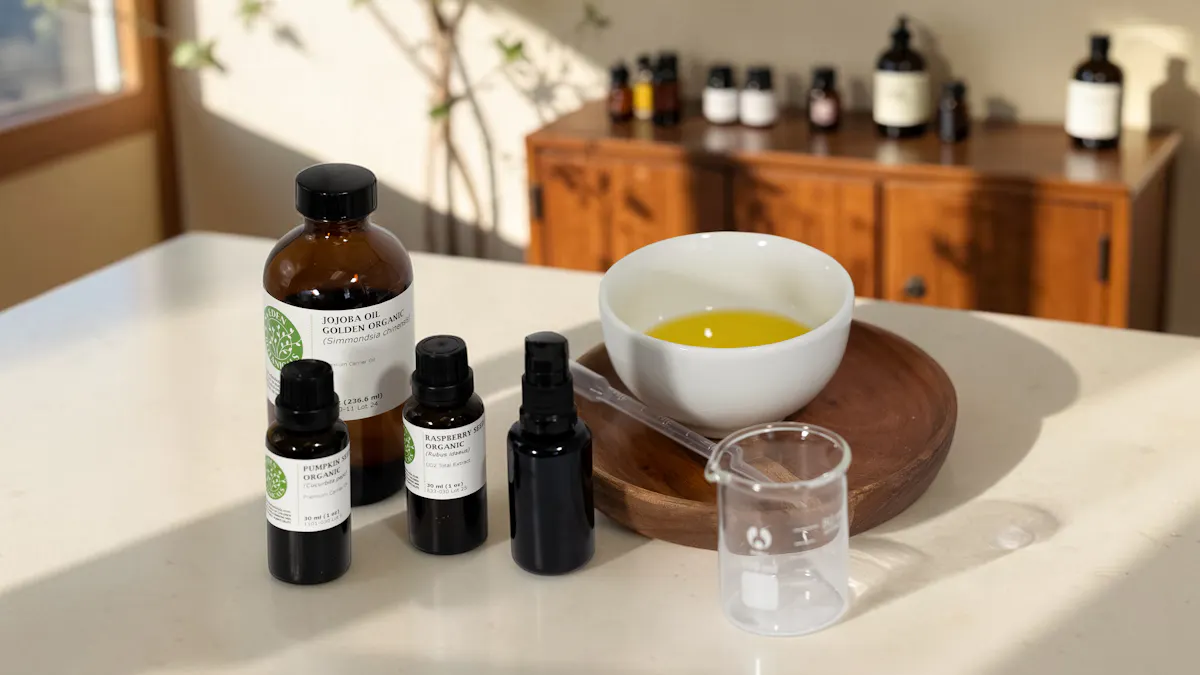
Set the 1 oz. bottle on a paper towel to absorb any spills. Use the large measuring stem pipettes to add each carrier oil (Marula, Jojoba, Pumpkin Seed, Rosehip Seed, Plum Kernel oils) to the bottle. Then, use the fine stem pipettes to add each essential oil (Lavender, Sandalwood, Frankincense, Blue Tansy).
If adding the Rosemary Antioxidant CO2, warm the Rosemary Antioxidant CO2 bottle in a bowl of warm water to liquify, shake well, then use a fine stem pipette to add it to your formula.
Twist on the pump top and gently shake to combine. Don’t forget to label the bottle with the name of your product, the date, and include the ingredients if possible.
Step Seven: Apply Your Facial Oil
Congratulations on creating your own custom facial oil! Start by testing a few drops on the back of your hand. Notice the aroma, texture, and how your skin feels afterward.
To use, apply a few drops to damp skin after cleansing, or skin that has been spritzed with a hydrosol, such Rose Hydrosol, before application. Gently press or massage the oil into your skin, avoiding the eye area.
Facial oils perform best on damp skin. Because oils are ‘hydrophobic’ (they naturally move away from water), pairing them with a light layer of moisture helps them spread easily, leaving your skin feeling silky rather than greasy.
You can use your facial oil once or twice daily, depending on your routine. Many people like to cleanse the skin at night followed by a facial oil. In the morning, a gentle warm water rinse may be all that is needed, followed by a light reapplication if desired. Facial oils can be layered under makeup or can be added to many store-bought beauty products or moisturizers to give them an added boost.
We recommend performing a patch test when working with any of our ingredients topically, especially before use on the face. Consult with your physician before using any essential oils if you are on medication or have a serious medical condition.
Final Notes for Formulators
While facial oils are at their best when used fresh, proper storage will extend their life. Kept in a cool, dark place, most facial oils will remain stable for about 6 months. If you’ve added an antioxidant, your formula may last for a year, or perhaps longer. Ultimately, shelf life depends on the stability of the carrier oils you’ve chosen. Be sure to store any unused portions of your carrier oils tightly sealed in the refrigerator.
Keep a journal of your formulations and how your skin responds so that you can recreate your favorites and adjust over time. You may notice that your skin craves richer oils in the colder months and lighter blends in the summer. Experiment with different essential oils to create new aromas, seasonal variations, and unique themes. Most importantly, enjoy the process, and have fun!
1 Shutes, Jade and Sherilyn Siegmund-Roach, The Carrier Oil Palette: Fixed Oils, Butters, Herbal Oils, and CO2 Extracts of the Carrier Oil Palette, 2022, pp. 178-187.
2 Ibid.
Featured Products
There are no products related to this article