6 min read
2026-09-11
Orris Butter – Unearthing a Perfumer’s Treasure
Written By: Robin Lander
This month in France, in the rolling golden fields of the Landes region, harvest is just beginning for one of perfumery’s most precious botanical treasures: Orris.
The rhizome of an Iris flower, Iris pallida, yields one of the rarest, most important, and luxurious materials in all of perfumery. The multi-faceted aroma is not easy to describe… delicate, sweet, warm and powdery with a floral aroma reminiscent of violet flowers and tenacious undertones of wood, earth, and musk.
Highly regarded by formulators for its remarkable fixative power, Orris has held legendary status for centuries for its ability to lend sheer elegance to fragrances, adding effects often described as captivating, transformative, and utterly euphoric.
For the next six months, the picking, cleaning, and extraction of rhizomes happen continuously at our facility in Le Sen to produce our premium Orris Butter, a semi-solid essential oil rich in aromatic compounds called irones.
Let’s dig deeper into the beautiful botanical behind our Orris Butter (15% irones) and learn how to use this enchanting material in your formulations.
Orris Cultivation, Harvest, and Curing
The use of Orris in perfumery began in ancient times where Egyptians, Greeks, and Romans collected Iris rhizomes and then dried, powdered, and processed them to make fragrant unguents (oily, semi-solid perfumes). The early Greek philosopher and botanist Theophrastus (372 - 287 BC) noted in his works on perfumery that the aroma of the rhizomes was best after 3 years of aging.[1]
Indeed, the aging and subsequent oxidation of the rhizomes leads to the development of irones, the molecules most responsible for the coveted powdery, creamy, violet-like scent.
But first, the Iris plants must be cultivated for three years. Traditionally, harvest begins in late summer after the flowers have come and gone, the rhizomes carefully picked by hand, peeled, and dried in the sun. After drying, they are left to age in sacks for 2-3 years. It’s during this time that the irones emerge and intensify – and the greater the irones, the more fragrant and valuable the extract.
The Tuscany region of Italy has been the main site of Orris cultivation for centuries, beginning during the Renaissance, however more recently farms have been established in both Morocco and France to help meet increasing demand.
Global production of Orris is quite low at just a few hundred tons per year. It takes 100 kg of rhizome powder to make just 200 grams of Orris Butter. This low yield combined with labor intensity contribute to the high cost of the material.
Innovative Production at our Le Sen Facility
Our production of Orris in the Landes region of France began after a dozen years of research, using the Italian produced Iris pallida as our model of quality. Cultivated on land once used for corn and surrounded by forests of maritime pine, we’ve been able to expand and modernize Orris cultivation and production to help increase yield.
Through a natural, proprietary drying process we’ve developed, the fresh rhizomes can be dried and treated in a few hours rather than the 2-3 years required by the traditional process. The resulting material is rich in aromatic irones, providing a consistent and sustainable alternative source for this precious aromatic.
Our Orris Butter contains 15% irones, a significant quantity that displays its full, impressive aromatic strength and diffusion in the long dry down.
What is Orris Butter?
Orris Butter is the steam distilled essential oil of the iris rhizome, yet it is one of the few distilled essential oils that is semi-solid at room temperature. Its waxy, buttery appearance gives it the name and is due to the presence of myristic acid, a saturated fatty acid also found in palm and coconut oils.
While some incorrectly refer to the material as Orris Concrète, Orris Butter is truly an essential oil. The material liquefies easily when gently warmed at low temperatures and is soluble in both fixed carrier oil and high-proof alcohol.
Orris as a Fixative and Enhancer
Orris Butter is revered for its exceptional fixative value, helping add longevity to fragrances of many types. However, Orris offers much more than fixation in a composition. It can:
· Smooth sharp edges with soft creaminess
· Amplify other notes it is paired with, especially florals
· Add velvety, woody depth and texture
· Lend creamy, musk-like effects
· Elevate perfumes with a luxurious quality
Formulating with Orris Butter
When should you reach for Orris Butter? Try it when you want to:
· Create an opulent base or heart note accord for high-end perfumery
· Give violet-like and dewy-floral effects, along with Cassie Absolute
· Add powdery, musky effects in Amber accords
· Amplify florals, such as Rose, Jasmine, Orange Blossom, and Tuberose
· Soften bright citruses and spices like Blood Orange and Cinnamon
· Enhance the leathery and metallic notes of Labdanum and Dynamone
· Complement fruity and berry-like notes like Carrot Absolute and Osmanthus Absolute
· Lend soft texture to Agarwood and Sandalwood
How Much Orris Butter to Use?
Tenacious without overpowering, it doesn’t take much to achieve its radiant effects in a formulation. Orris Butter can grow deeper and bloom significantly in a formula as it matures, so it’s best to start small and slowly work your way up, if needed. Many fine fragrances use 0.25% - 1% Orris Butter in a composition, however when Orris is the star of a perfume, it may be used as high as 5% or more.
Pro Tip: Due to the cost of Orris, many perfumes today contain ionones, – either synthetically produced compounds or naturally-derived isolates – perfume materials with a similar violet-like floral aroma. Versatile and inexpensive, alpha and beta-ionone have dominated iconic powdery, violet and berry-like fragrances for the last century. However useful, they simply don’t reproduce the full complexity and depth of authentic Orris, not to mention the prestige that can come with using the natural material.
How to Work with Orris Butter (15% irones)
Orris Butter is a light yellow, opaque, wax-like, semi-solid material that must be gently warmed to become pourable. It is soluble 190-proof alcohol and in fixed carrier oils such as Fractionated Coconut Oil - Organic or Jojoba Oil, Golden – Organic.
To make thicker materials like Orris Butter easier to handle, many formulators prepare a 5% - 10% dilution to work with, adding this dilution to their formulation rather than trying to add the viscous, buttery material directly. Here’s how to do it:
Make a 10% Orris Butter Dilution in 90% Jojoba Oil
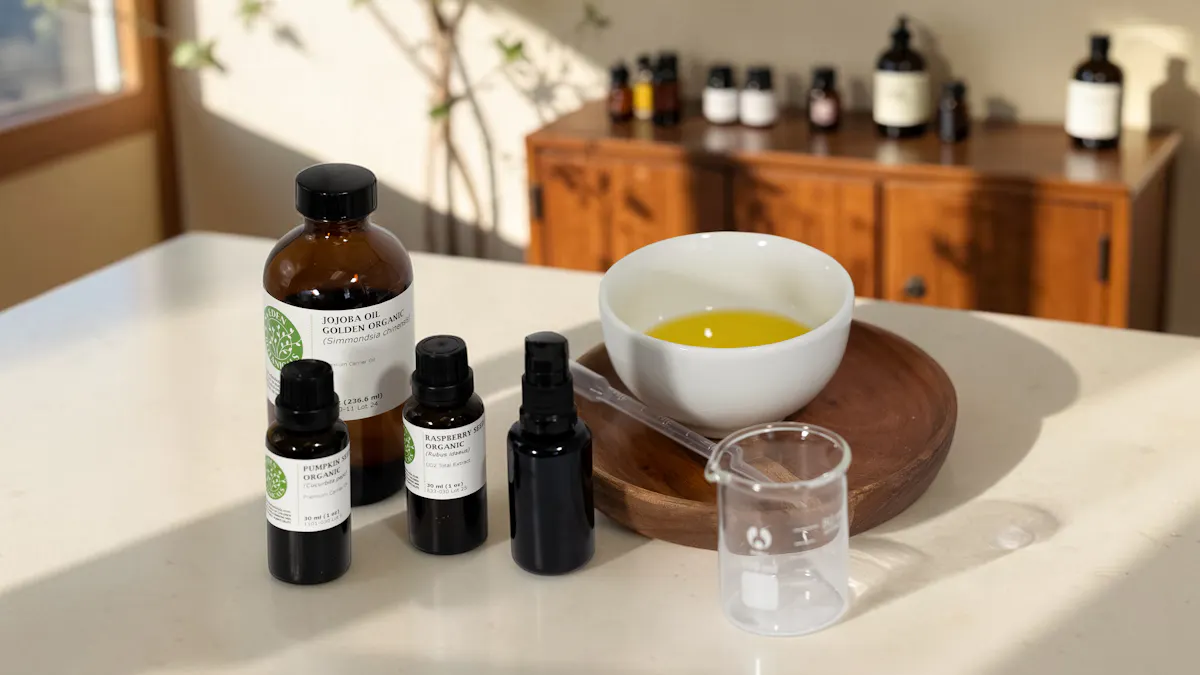
1) For best results, use a scale for accuracy. Consider the total weight of the dilution you’d like to make and weigh out the parts. A 10% dilution is one part Orris Butter to 9 parts Jojoba Oil, Golden – Organic. For example: 1 gram of Orris Butter in 9 grams of Jojoba Oil is a 10% dilution that will make 10 grams (approximately 11.5 ml) of diluted material.
2) Gently warm the bottle/container of Orris Butter in a warm water bath until mobile. Orris Butter will liquify at a low temperature of 100°F to 120°F. If your bottle is small, you can pour hot water in a shallow dish, then set the bottle of Orris Butter in it for just a few minutes.
3) Meanwhile, warm a small beaker with the Jojoba Oil in a water bath to about 120°F (use a thermometer), then remove from heat.
4) Transfer the warmed, mobile Orris Butter to the warmed Jojoba Oil.
5) Stir the mixture until the materials fully incorporate.
6) Pour into a dark bottle and label your dilution. For best aromatic results, wait 24 hours for the Orris Butter to fully harmonize with the Jojoba Oil.
Make a 10% Orris Butter Dilution in 90% High-Proof Ethyl Alcohol
1) Follow Steps 1 and 2 the same as above, weighing out your alcohol instead of Jojoba Oil.
2) Have your weighed alcohol ready and waiting at room temperature in new container or bottle. Never heat alcohol – room temperature alcohol is fine.
3) Transfer the warmed, mobile Orris Butter to the alcohol.
4) Stir the mixture until the materials fully incorporate. It may take time for full incorporation, and you can swirl the container periodically to help the process.
5) Store in a dark bottle and label your dilution.
For detailed instructions of different warming methods and other helpful tips, please see our article on Blending with Viscous Aromatics.
From Iris Rhizome to Fine Fragrance
With the harvest season of Iris rhizomes well underway, we are excited to continue this year’s production of Orris Butter (15% irones) for your perfumery creations. Like many of the most precious aromatic materials, it can take a little practice to learn how to incorporate Orris Butter into your formulations. We offer small samples for purchase so you can experience this fascinating material first-hand and discover its transformative character. We hope you find it a treasure worth digging for.
References
1 Groom, Nigel. The New Perfume Handbook, 2nd ed., 1997, p. 240.