Solubility & Blending Suggestions

  • Dilute well (a little goes a long way) and add drop by drop to your blends until the desired effect is achieved. A maximum dermal use level of 1.0% is recommended.
  • Soluble in fixed (carrier) oils and alcohol.
  • Holy Basil essential oil can be found in the top notes of fougère fragrances and also in balsamic compositions.*
  • *Rhind, Jennifer Peace. Fragrance and Wellbeing, 2014, p. 234.

    Suggested Resources

    • Essential Oils - A Handbook for Aromatherapy Practice, Jennifer Peace Rhind, 2012, pp. 108, 110, 170.
    • Aromatherapeutic Blending - Essential Oils in Synergy, Jennifer Peace Rhind, 2016, pp. 83, 98, 109, 126, 135, 149, 191-2.
    • The Complete Book of Essential Oils and Aromatherapy, Valerie Ann Worwood, 2016, pp. 535, 569.

    Tulsi (Holy Basil) EO

    Ocimum sanctum L. (synonym of Ocimum tenuiflorum L.)

    (6)

    SKU 973-G sizes:

    Sample 1 ml (1/30 oz)
    $3.00
    15 ml (1/2 oz)
    $13.00
    30 ml (1 oz)
    $22.00
    59.14 ml (2 oz)
    $38.00
    118.29 ml (4 oz)
    $67.00
    236.58 ml (8 oz)
    $120.00
    473.17 ml (16 oz)
    $217.25
    1 kg (2 1/5 lb)
    $426.75

    Contact us for bulk inquiries.

    Botanical NameOcimum sanctum L. (synonym of Ocimum tenuiflorum L.)
    Suggested UseAromatherapy, Perfumery, Cosmetics, Soapmaking, Candle Crafting
    INCI NameOcimum Sanctum (Holy Basil) Leaf Oil
    CAS Number91845-35-1
    OriginIndia
    Extraction MethodSteam Distilled
    CultivationConventional
    Plant Partflower, leaves.
    Notetop, middle.
    Aroma Familyanisic, green.
    Aroma ProfileSweet, pungent, clove-like, somewhat bitter green/herbaceous aroma, with a soft balsamic-woody undertone; very persistent sweetness.
    AppearanceLight yellow to brown, transparent, mobile liquid.
    Shipping Restriction0 – Non-Hazardous

    Safety Considerations

    • Caution: contains methyleugenol. If you have a medical condition or are taking medication, please consult with a physician before use. Avoid in cases of blood clotting or bleeding disorders.* There is a moderate risk of skin sensitization and low risk of mucus membrane irritation; a maximum dermal use level of 1.0% is recommended.**
    • Dilute before using. A patch test should be performed before use for those with sensitive skin.
    • Store in a cool, dark place away from heat and light.
    • *Tisserand, Robert and Rodney Young. Essential Oil Safety, 2nd ed., 2014, p. 204.
    • **Ibid.

    Tulsi (Holy Basil) EO

    Ocimum sanctum L. (synonym of Ocimum tenuiflorum L.)

    (6)

    Our Holy Basil (Tulsi) essential oil has a sweet, pungent, clove-like, somewhat bitter green/herbaceous aroma, with a soft balsamic-woody undertone; it also has a remarkably persistent sweetness. Eugenol is the predominant chemical constituent in this species of Basil, which accounts for its clove-like scent,

    Size

    Selected size SKU:973-016 - Tulsi (Holy Basil) 15 ml (1/2 oz) (w/ orifice reducer)

    Sample 1 ml (1/30 oz)
    $3.00
    15 ml (1/2 oz)
    $13.00
    with orifice reducer
    30 ml (1 oz)
    $22.00
    59.14 ml (2 oz)
    $38.00
    118.29 ml (4 oz)
    $67.00
    236.58 ml (8 oz)
    $120.00
    473.17 ml (16 oz)
    $217.25
    1 kg (2 1/5 lb)
    $426.75
    $3.00
    Details
    Solubility & Blending Suggestions
    Suggested Resources
    Safety Considerations
    Certificates of Analysis (COA)
    Documentation

    Product Overview

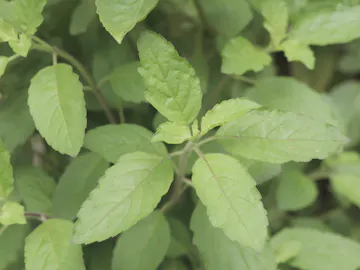
    Our Holy Basil (Tulsi) essential oil has a sweet, pungent, clove-like, somewhat bitter green/herbaceous aroma, with a soft balsamic-woody undertone; it also has a remarkably persistent sweetness. Eugenol is the predominant chemical constituent in this species of Basil, which accounts for its clove-like scent, along with methyl chavicol (aka estragole), also present but in a much smaller percentage. [1],[2] Holy Basil's eugenol content is brightened and supported by a lively bouquet of energetic monoterpenes and a fair amount of the oxide, 1,8-cineole.

    Ocimum sanctum, a species native to India, is worshipped as the plant of Lakshmi, consort of Vishnu, and thus considered a sacred plant. It is grown near temples and in home courtyards to invite the presence of the gods and freshen the air.[6] Among its worthy attributes, it is said that Basil opens the heart and brings harmony to the mind and spirit. [7] Not the easiest oil to source, this is the well-rounded and tenderly produced Holy Basil we have been waiting for.

    Tulsi is well suited in elevating diffuser blends and room sprays, and in low dilutions in meditation and massage blends, steams and chest rubs.

    1 Industry communication.

    2 Rhind, Jennifer Peace. Listening to Scent - An Olfactory Journey with Aromatic Plants and Their Extracts, 2014, p. 71.

    6 Rhind, Jennifer Peace. Essential Oils - A Handbook for Aromatherapy Practice, 2nd ed., 2012, p. 170.

    7 Miller, Light and Bryan. Ayurveda & Aromatherapy, 1995, p. 222.


    Product Overview

    Our Holy Basil (Tulsi) essential oil has a sweet, pungent, clove-like, somewhat bitter green/herbaceous aroma, with a soft balsamic-woody undertone; it also has a remarkably persistent sweetness. Eugenol is the predominant chemical constituent in this species of Basil, which accounts for its clove-like scent, along with methyl chavicol (aka estragole), also present but in a much smaller percentage. [1],[2] Holy Basil's eugenol content is brightened and supported by a lively bouquet of energetic monoterpenes and a fair amount of the oxide, 1,8-cineole.

    Ocimum sanctum, a species native to India, is worshipped as the plant of Lakshmi, consort of Vishnu, and thus considered a sacred plant. It is grown near temples and in home courtyards to invite the presence of the gods and freshen the air.[6] Among its worthy attributes, it is said that Basil opens the heart and brings harmony to the mind and spirit. [7] Not the easiest oil to source, this is the well-rounded and tenderly produced Holy Basil we have been waiting for.

    Tulsi is well suited in elevating diffuser blends and room sprays, and in low dilutions in meditation and massage blends, steams and chest rubs.

    1 Industry communication.

    2 Rhind, Jennifer Peace. Listening to Scent - An Olfactory Journey with Aromatic Plants and Their Extracts, 2014, p. 71.

    6 Rhind, Jennifer Peace. Essential Oils - A Handbook for Aromatherapy Practice, 2nd ed., 2012, p. 170.

    7 Miller, Light and Bryan. Ayurveda & Aromatherapy, 1995, p. 222.
     

    logo

    2026-09-25

    Lavender, Kashmir – The Sweet, Honeyed Lavender of the Himalayas

    The Kashmir Valley in India is certainly a special place. Surrounded by the snow-capped Pir Panjal and Greater Himalayan mountain ranges, this protected, picturesque valley sits at an elevation of 6,000 feet, with fertile conditions and a moderate climate well suited for growing Lavender.

    logo

    2026-09-24

    Lowdown on Lavender – Which One Should I Buy?

    There’s nothing quite like standing in a Lavender field at the height of bloom. The summer sun sits high in the sky, bees drift lazily between blossoms, endless rows of violet stretch across gently sloping hills, and the air is saturated with the unmistakable scent of sweet floral herbaceousness.

    logo

    2026-09-18

    Beautiful Bergamot – A Formulator’s Bridge Between Citrus and Floral

    There’s a reason why formulators rave about Bergamot essential oil. With its bright citrus top note and delicate floral character, it’s a natural union of both worlds in a single bottle.