4 min read
2025-09-19
Tracing the Scent – A Journey to Sustainable Agarwood
Written By: Robin Lander
The following is compiled from our report by Lorenzo Bonaventura, part of our global purchasing team based in Northern Italy.
Agarwood essential oil is one of perfumery’s most rare and coveted natural materials. Known for its multi-dimensional depth, complexity, and tenacity, Agarwood’s unique, sweet, warm woody aroma brings luxurious richness and intrigue to high-end and niche fragrances. The scent forms the basis of the legendary Arabian perfume called Oud, used for centuries in spiritual practice and meditation.
Yet like many prized aromatic woods, Agarwood trees have been heavily overharvested in the wild and are now critically endangered. To protect this treasured resource, our dedicated producer in Vietnam has developed a sustainable method to produce Agarwood on a managed plantation. Earlier this year, our sourcing team visited their operation to learn firsthand how they’re ensuring a future for this extraordinary material.
A Response Born in Nature
Our journey began in Vietnam’s tropical south where we learned about Agarwood trees and their irresistible fragrance. There are several species in the genus Aquilaria, flowering trees that grow throughout Southeast Asia and northeastern India. However, the aroma only comes from trees that have been infected by a parasitic fungus.
In response, the trees produce a highly aromatic resin to defend themselves. After a few years, the affected heartwood becomes dark, dense, and saturated with aromatic resin. In nature, this infection is often initiated by insects, such as the Ambrosia beetle, but the process can take decades and is also unpredictable.
Meanwhile, high global demand for Agarwood essential oil has led to severe overharvesting of wild populations, the use of harsh chemicals to induce stress, and a marketplace rife with adulterated Agarwood oil.

Innovation through Sustainable Cultivation
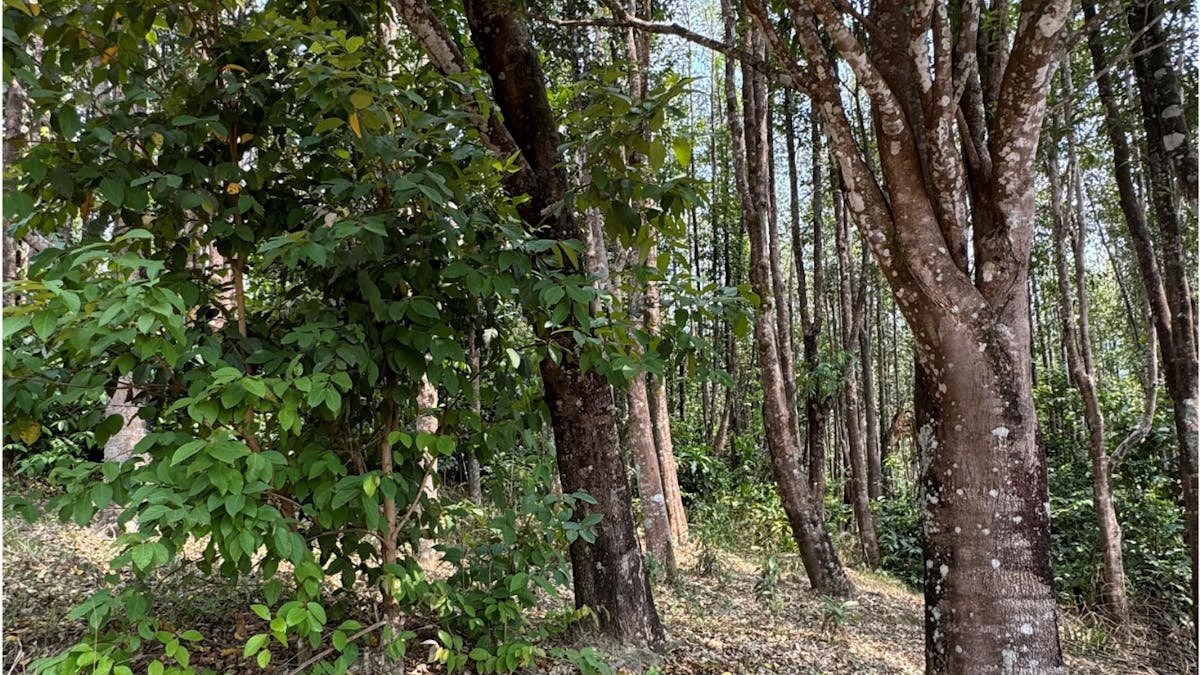
Our producer in Vietnam has developed a careful, long-term approach. Their family-run business manages a plantation spanning over 300 hectares, interplanting Agarwood and Rubber trees. With 2,000 trees per hectare, they currently nurture more than 400,000 Agarwood trees.
Each year, they harvest no more than 5,000 mature trees while planting over 50,000 new saplings from their nursery, a regenerative cycle supported by 60 full-time and 40 seasonal workers.
Mimicking Nature with Gentle Inoculation
Once Agarwood trees reach at least seven years old, workers drill small holes in the trunk and introduce an enzyme to trigger the resin production. This controlled inoculation is done on 3,000–4,000 trees per year during the rainy season. After one to three years, carefully selected trees are harvested for distillation, not exceeding 5,000 trees per year.
The Production and Distillation Process
Harvested trees are brought to the manufacturing facility where the black, resinous parts of the wood are manually separated by hand. The wood is ground into a fine powder and then soaked in water for 10-14 days. The powder is then gently hydrodistilled at a low temperature over a four-day period.
It takes about 1,000 kg (2,200 lbs.) of resinous wood to yield just 1 kg (2.2 lbs.) of Agarwood essential oil. Despite year-round operations, their total production is only around 30 kg annually. To make the most of the wood, the powder remaining after distillation is dried and used to manufacture incense.
The Aroma of Agarwood
The resulting Agarwood essential oil is magnificent: deeply complex with highly persistent sweet warmth and precious woody richness layered with smoky, ambery incense, honeyed tobacco, and subtle animalic undertones reminiscent of musk and castoreum.
For those looking for an easy-to-use, economical option, we offer Agarwood – 5%, a diluted blend of 5% Agarwood essential oil in 95% organic Fractionated Coconut oil.
Revered for centuries, Agarwood essential oil holds a place of honor in sacred rituals, ceremonial anointing, and the palettes of natural perfumers worldwide.
A Sustainable Future for Agarwood
Through careful management and innovative cultivation, our producer is helping secure the future of one of perfumery’s most precious natural treasures. We’re proud to partner with our visionary producer in Vietnam to bring you a premium, sustainably produced Agarwood essential oil.
We have CITES certification that notes this product was legally imported and cleared by the US Fish and Wildlife Service. However, due to CITES regulations set in place to protect the trees, we cannot ship this material to locations outside of the USA.